


Chin Filler vs Jawline Filler: What’s the Difference and Which Do You Actually Need?
Key Takeaways
- They treat different problems: Chin filler improves forward projection and side-profile balance, while jawline filler adds definition and contour along the mandibular border from jaw angle to chin. They are not the same treatment.
- The injection zones do not overlap: Chin filler is placed directly into the mentum (the central chin tissue), whereas jawline filler is distributed along the lower border of the jaw, sometimes as far back as the gonial angle near the ear.
- Product choice and density matter: Both treatments typically use high G-prime, structurally firm hyaluronic acid fillers, such as Juvéderm Volux, specifically formulated for the jaw and chin region. These are quite different in consistency from the softer gels used in lips or cheeks.
- Longevity varies by area: Results in the jawline can last anywhere from 12 to 24 months due to lower tissue mobility, while chin filler generally lasts 6 to 18 months, depending on the product used, the volume placed, and individual metabolism.
- Many patients benefit from both: A soft jawline is not always caused by the jawline itself. A recessed or under-projected chin can make the whole lower face look less defined, which means treating only one area may deliver an incomplete result. A proper facial assessment is the only reliable way to know which, or both, you actually need.
Chin filler and jawline filler are two separate treatments that target entirely different anatomical structures and solve different aesthetic problems. Chin filler addresses the projection and shape of the chin itself, primarily changing how your face looks from the side. Jawline filler adds definition and contour along the lower border of the jaw, sharpening the transition between your face and neck and improving the front-on and angled views. Confusing the two is one of the most common reasons patients end up with a result that doesn’t match what they wanted.
What Each Treatment Actually Does: The Core Breakdown
Before comparing the two, it helps to understand each treatment on its own terms. They share a similar process at the surface level (a consultation, topical anaesthetic, injectable hyaluronic acid filler, minimal downtime), but their goals, injection locations, and the results they produce are distinct.
- Chin filler (non-surgical chin augmentation): Chin filler is a specialised injectable treatment designed to enhance the size, shape, and projection of the chin. Using hyaluronic acid-based dermal fillers, the practitioner can subtly augment the chin’s contours, improving symmetry and helping balance the lower third of the face. It is particularly valuable for those who feel their chin is recessed, short, or asymmetrical. The filler is placed into the central chin tissue (the mentum), and the focus is almost entirely on the side profile. When the chin sits too far back, it pulls the lower face inward, affecting how the lips, jawline, and even the nose appear from the side. Because the chin is relatively stable and less mobile than other facial areas, filler placed here often creates a noticeable profile improvement without needing large volumes.
- Jawline filler (jawline contouring): Jawline filler focuses on definition and contour, not projection. It is placed along the mandibular border to create a clearer outline between the face and neck. Jawline fillers are a more dense type of dermal filler containing a high concentration of hyaluronic acid. When applied at specific points along the natural structure of the jaw, the smooth gel works to add volume beneath the skin to gently lift and sculpt the chosen area. Rather than a single injection point, jaw filler targets the mandibular angle and the pre-jowl sulcus to create a sharp line from the ear to the chin.
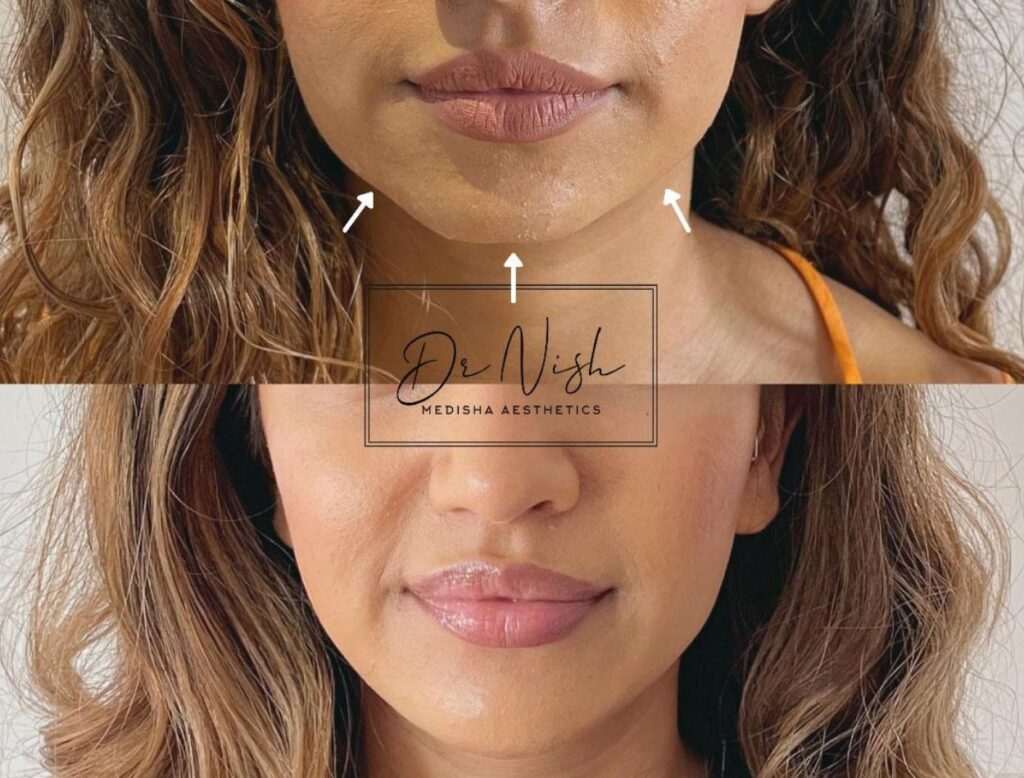
Side-by-side profile images showing a recessed chin before and after chin filler treatment, illustrating the forward projection and improved nose-to-chin balance.
- How the consultation and treatment process works (both treatments): The process begins with a thorough consultation to understand your goals and concerns. The practitioner evaluates your facial features, chin shape, and overall proportions to determine the best approach. The treatment area is cleansed and a topical numbing cream or local anaesthetic is applied for comfort, then the filler is carefully injected into specific areas to add volume and enhance contours, tailored to your unique anatomy. For the jawline in particular, most jawline filler procedures are performed using a blunt cannula, which helps reduce bruising, improve safety, and allow smooth placement along the jawline. The overall treatment is usually expeditious, lasting 15 to 30 minutes.
- What happens after treatment: Results are visible straight away. After the procedure, patients may notice some mild swelling or bruising, which typically settles within a few days. It is best to avoid strenuous exercise, alcohol, and excessive heat for 24 to 48 hours and refrain from touching or massaging the treated area unless instructed to do so. Results are visible immediately and continue to improve as any initial swelling subsides. For the first two weeks, avoid dental work if possible, as prolonged pressure on the jaw can affect filler placement. Be gentle when washing your face and avoid any facial treatments or massages.
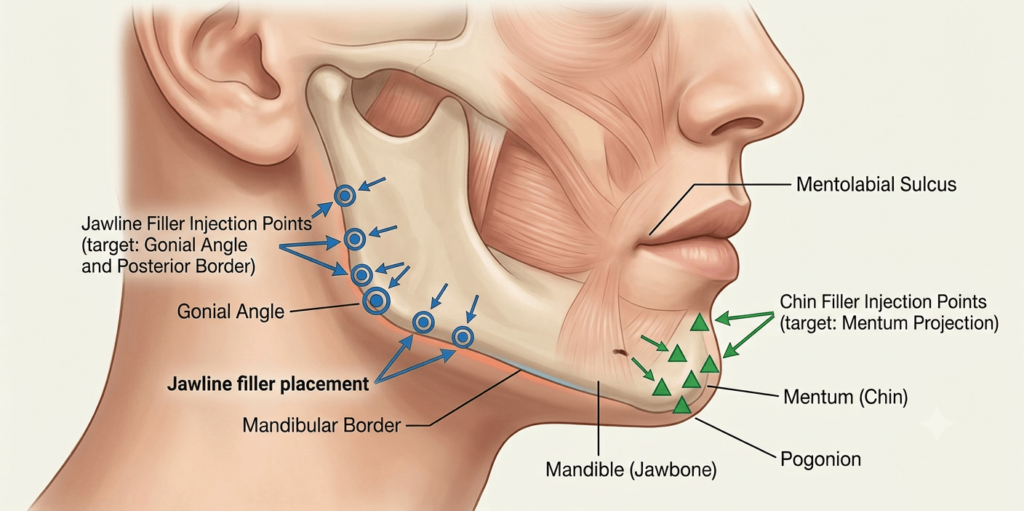
Close-up diagram of the lower face showing the mandibular border, gonial angle, and mentum, with annotated injection points for jawline (Blue) versus chin (Green) filler placement.
Realistic Timelines, Longevity, and UK Pricing
Cost is often the first thing patients want to know, and it varies more for these two treatments than for many other aesthetic procedures. The reason is straightforward: the jawline covers more surface area and usually needs more product than the chin.
- Chin filler longevity: Chin filler typically lasts between 6 and 18 months. The variation depends on the product used (higher-density fillers with a stronger cross-linked structure generally last longer), the volume placed, and how quickly your body metabolises the hyaluronic acid. Adequate volume in the right location tends to last longer than very small amounts spread thinly. This is why the initial treatment plan matters so much. Underfilling to save cost often means the result doesn’t hold as well, and you end up needing more frequent top-ups.
- Jawline filler longevity: Fillers can last 18 to 24 months in the jawline due to the area’s relatively low mobility. Jawline fillers should be repeated about once a year on average, though this is individual. Lifestyle also plays a role: smoking, excessive alcohol consumption, and chronic sun exposure can all accelerate the breakdown of filler, as well as age the skin independently.
- How much product is needed: One of the most common questions is whether 1ml of chin filler is enough. For many people, 1ml can provide a noticeable enhancement, especially if you’re looking for subtle contouring or a slight projection boost. However, if you want a more dramatic change or have a larger chin area to fill, you might need 1.5ml or even 2ml. For the jawline, the picture is different: most treatments are priced per ml, and a defined jawline usually requires 2 to 4ml for visible results.
- UK pricing context: For chin filler, as of mid-2026, the cost for chin filler in London generally falls between £400 and £1,200, with 1ml typically costing between £300 and £500. For jawline filler, costs in the UK typically range between £400 and £1,200, depending on how many ml are used, the clinic location, and the practitioner’s expertise. Because the jawline generally requires more product, a jawline and chin contouring treatment can require 2 to 4ml in total. Some clinics price per ml, while others offer a package. A realistic budget for both treatments combined, at a reputable medically-led clinic, tends to sit in the region of £800 to £1,500. These figures are indicative; the only way to get an accurate quote is after a face-to-face consultation and clinical assessment.
- When results are at their best: Results following jawline filler treatment develop gradually as the filler settles and integrates with surrounding tissue. Within one to two weeks, improvements in contour and symmetry become clearly apparent, with the full outcome emerging once any initial mild swelling has resolved. Most practitioners schedule a review appointment at around four weeks.
Who Is Each Treatment Suited To?
This is where the real decision-making happens, and it matters because choosing the wrong treatment can leave you with a result that looks off even if the filler itself was placed perfectly. The lower face has to be assessed as a whole.
- You are likely a candidate for chin filler if: Your concern is primarily the side view. A recessed chin can make the nose look larger, shorten the lower face, and soften the transition between the face and neck. If you look in the mirror from the side and feel your face lacks projection at the front, or your chin appears to disappear into your neck, chin filler is usually the more targeted solution. This includes individuals seeking to lengthen the chin for improved facial harmony and those with a short, receding, or asymmetrical chin who want to enhance facial symmetry and balance.
- You are likely a candidate for jawline filler if: Your concern is definition when looking straight on or at an angle. Jawline filler is placed along the mandibular border to create a clearer outline between the face and neck and is especially helpful for patients who feel their jawline looks soft, uneven, or less defined than it used to be. These issues often involve a lack of facial structure that makes the face appear less sculpted and can be particularly noticeable with age-related changes such as jowls and skin laxity around the neck, chin, and décolletage.
- You may benefit from both if: Patients often ask for jawline filler when the main issue is actually a recessed chin or under-chin fullness. In those cases, adding filler along the jawline alone may not create the result the patient expects. For patients where chin projection or chin asymmetry contributes to an imbalanced lower face, a combined jaw and chin filler treatment addresses both structures simultaneously. This produces a more proportionate result than treating the jawline in isolation.
- When filler may not be the right answer: Not everyone is a suitable candidate, and a responsible practitioner will say so. Jawline filler does not tighten loose skin or remove fat. It works best when the underlying issue is related to shape and support rather than excess tissue. Jawline filler cannot fix a double chin because it does not remove fat. Fat-dissolving injections are more effective in that case, sometimes combined with chin filler. Equally, jawline filler cannot correct deeper issues such as bite misalignment, TMJ disorders, or skeletal discrepancies. These require proper medical or dental evaluation and treatment.
Deeper Dive: Four Things Most Patients Get Wrong About These Treatments
Myth 1: Chin Filler and Jawline Filler Are Just Different Names for the Same Thing
This is the root cause of most patient confusion and the reason people end up dissatisfied with results they didn’t actually need. Chin fillers differ from jawline fillers in their purpose. Chin fillers, unlike jawline fillers, are injected into the chin tissue only. Chin filler changes projection and profile balance, while jawline filler improves contour and definition. Think of it this way: if you want your profile photo to look different, you probably need chin filler. If you want the front-facing or angled photograph to look sharper and more structured, jawline filler is the more relevant treatment. Both can be needed, but they are not interchangeable.
Myth 2: These Fillers Use the Same Product as Lip Filler
The hyaluronic acid base is similar, but the product formulation for structural lower-face work is meaningfully different. Unlike the softer gels used for lips, chin filler requires a high G-prime, which refers to the gel’s hardness and its ability to resist deformation. Premium products like Juvéderm Volux or Restylane Lyft are used to mimic the density of bone. Juvéderm Volux also has a high G-prime, and this results in its unique ability to resist deforming forces and greater projectional capacity, which is ideal for jawline contouring. This matters practically because a softer filler placed in the jaw area will migrate more easily under the mechanical pressure of chewing and talking, whereas a firm structural filler integrates with the tissue and holds its position. A peer-reviewed case report published in a clinical journal noted that hyaluronic acid-based fillers have a confirmed history of safe and effective use for treating facial volume loss or deficiency, and that Juvéderm Volux is a safe, effective, and long-lasting alternative for restoring and creating facial volume and sculpting, shaping, and contouring the chin and jaw.
Myth 3: A Soft Jawline Just Needs More Jawline Filler
This is one of the most clinically important misconceptions because acting on it can lead to overfilling without improving the result. A soft jawline is not always caused by the jawline itself. Sometimes the chin is under-projected, making the lower face look less balanced. In other cases, the chin is well positioned, but the jawline lacks definition. Treating one area without assessing the other can lead to overfilling or imbalance. One of the most common mistakes with lower face filler is focusing on a single feature. Experienced practitioners stress that if you are comparing the two treatments, the most important step is a proper facial assessment. The lower face should be treated as a whole, not as isolated features. A patient who comes in asking for more jawline filler may leave with a better result from a modest amount of chin filler instead. This kind of honest redirection only happens at a clinic that puts the outcome ahead of the sale.
Myth 4: The Results Will Look Obvious and Unnatural
The fear of looking “done” is real and understandable, particularly with lower-face treatments that can influence such a significant part of the face’s structure. The reality is that done correctly, chin fillers look incredibly natural. The key lies in the skill of the practitioner. By using small amounts of filler and placing it strategically, the results enhance the patient’s natural features rather than create an artificial appearance. The same principle applies to jawline filler. A recessed or short chin affects how the entire lower face sits in relation to the nose and lips. Improving chin projection can subtly shift the balance of the face without making it obvious that filler was used. Treatments that go wrong tend to involve too much product, an unsuitable candidate, or poor technique. That is why the NHS recommends choosing practitioners with appropriate training, skills and insurance, and asking about aftercare, complications and what happens if something goes wrong.
There is also the question of the UK’s evolving regulatory landscape. A new licensing scheme in England will require both individual practitioners and the premises they work from to be licensed by their local authority. Dermal fillers fall into the Amber category. Because they carry a higher risk, there are extra rules. A qualified medical professional can perform them independently, while a non-medical practitioner can only perform Amber procedures under the oversight of a named, regulated healthcare professional. For patients, this means asking about a practitioner’s qualifications and whether the clinic operates under medical oversight is not just a sensible precaution; soon it will be a basic legal standard.
Why Choose a Qualified, Medically-Led Practice for Chin and Jawline Filler
Lower-face filler sits in a part of the face with important vascular structures, and the difference between a natural-looking result and a problematic one often comes down to anatomical knowledge, product selection, and the willingness to say no when a patient isn’t a suitable candidate. A clinic that properly assesses you from the front, the side, and the three-quarter angle before recommending anything, that carries hyaluronidase on site for emergencies, and that offers a review appointment after treatment is demonstrating exactly the kind of standard patients should be looking for. When booking any consultation for chin or jawline filler, check that the practitioner is registered with the GMC, NMC, or GDC, and ask what happens if you experience any concern after leaving the clinic.
Frequently Asked Questions
Can chin filler make my nose look smaller?
A recessed chin can make the nose look more prominent, the lower face look shorter, or the neck look less defined. In these cases, adding careful projection to the chin can improve the profile without changing the nose or jawline directly. So yes, improving chin projection can create the visual impression of a smaller or more proportionate nose because it restores the correct balance between the two features. This is why non-surgical chin augmentation is sometimes recommended alongside or instead of non-surgical rhinoplasty for patients whose main concern is nose size in profile.
How do I know if I need chin filler or jawline filler without seeing a practitioner?
A rough self-assessment: take a side-profile photograph and a front-facing photograph in natural light. If your side profile looks soft and your chin seems to recede toward your neck, chin filler is likely the more relevant treatment. If the front-facing or three-quarter view looks undefined and lacks a clear jaw edge, jawline filler may be more appropriate. That said, consultations matter because treating one area without assessing the other can lead to overfilling or imbalance. A self-assessment can help you frame the conversation, but it cannot replace a clinical facial assessment before any treatment is booked.
Is jawline filler reversible if I don’t like the result?
Jawline filler can be safely dissolved with an enzyme called hyaluronidase. This allows correction in rare cases of filler complications. The same applies to chin filler, since both treatments typically use hyaluronic acid-based products. The wonderful thing about using hyaluronic acid fillers for jawline augmentation is that, like anywhere else they are used, they can be reversed if necessary. If you do not like your results or want to return to your natural appearance, your practitioner could use hyaluronidase. This enzyme will metabolise the dermal filler and restore your jawline to its pretreatment shape. Reversal is not instant and may require more than one session for complete dissolution, but it is a meaningful safety net that makes hyaluronic acid the preferred choice over non-reversible fillers for this area.
What are the risks of chin and jawline filler?
Common side effects include temporary redness, swelling, or bruising at the injection site. These are usually mild. Rare risks such as infection or asymmetry will be discussed with you in advance by your practitioner. The more serious, though rare, risk associated with any filler in the lower face is vascular occlusion, where filler is inadvertently placed near a blood vessel. You should contact the clinic urgently if you experience severe pain, skin colour changes, unusual swelling, signs of infection, or symptoms that do not feel normal. This is why a well-equipped clinic that carries hyaluronidase on site and has a clear emergency protocol is non-negotiable for lower-face filler treatment. Although uncommon, vascular occlusion and delayed inflammatory reactions can occur. Clinics should maintain hyaluronidase and an emergency protocol on site, and provide clear after-hours contact for urgent concerns.
Do chin and jawline fillers look different on men versus women?
Chin fillers are becoming increasingly popular among men, who use them to achieve a strong, masculine jawline and a balanced profile. The treatment is tailored to suit the unique anatomy and goals of each patient, regardless of gender. The key distinction is in the aesthetic goal: for female patients, practitioners typically aim for a softer, more tapered lower third with gentle projection, whereas for male patients, the practitioner considers whether they are masculinising or feminising depending on the patient’s gender, concerns and goals, and this should be discussed fully during clinical consultation and should not be assumed. Product placement and volume will differ accordingly. A well-trained injector will discuss these goals during consultation, not assume them.
How long after jawline or chin filler can I see the full result?
You will see an immediate change when you leave the clinic, but the final result takes a little longer to settle. Results are immediate, though mild swelling may slightly change the appearance in the first few days after treatment. The final look mellows out within two weeks. Optimal results can generally be seen from three to four weeks post treatment. Most clinics schedule a review at around that four-week mark to assess the outcome and determine whether any subtle refinement is needed. It is worth noting that swelling in the jaw area can be slightly more pronounced than in other facial areas and can occasionally last up to two weeks in some patients, so avoid scheduling important events immediately after treatment.
Can I have other treatments alongside chin and jawline filler?
You can combine jawline and chin filler with other skin-tightening treatments and cosmetic procedures, depending on your goals and your clinician’s advice. Common combinations include chin and jawline fillers together to improve overall facial balance and symmetry, cheek filler to complement jawline filler treatments and create a more balanced facial profile, and botulinum toxin injections to relax muscles that cause a sagging jawline. That said, combining treatments in a single session should always be led by clinical necessity rather than convenience. Filler can improve the look of early jowls, but it is not a replacement for a surgical facelift in cases of significant sagging. In more advanced cases, filler alone may not be enough, and an honest practitioner will tell you whether a different treatment or a combination approach would serve you better.
Is jawline filler the same as masseter Botox for jaw slimming?
No. These are completely different treatments with opposite effects. Jawline filler adds volume and structure to build definition along the lower border of the jaw. Masseter botulinum toxin (often called jaw Botox or masseter reduction) relaxes the masseter muscle on the side of the face, which over time reduces the bulk of that muscle and slims a wide or square jaw appearance. Injecting a neuromodulator can reduce the size of the masseter muscle, helping reduce the appearance of an overly square jaw and slimming the jawline. Someone who wants a sharper jaw edge needs filler; someone whose jaw looks too wide or square due to muscle bulk may benefit from masseter botulinum toxin. In some cases, both are used together as part of a lower-face plan.
What questions should I ask at a filler consultation?
A good starting point is to ask your practitioner to explain exactly which area they are proposing to treat and why, what product they intend to use and why that specific product suits your anatomy, how many millilitres they are recommending, and what they would do if you experienced a complication. A responsible consultation should include medical history, allergies, previous filler, medication, skin condition, and expectations. You can also verify the professional by checking their name on the statutory register (GMC for doctors, NMC for nurses, GDC for dentists) and voluntary registers like the JCCP. Never book a treatment that doesn’t offer a separate consultation, and if a practitioner wants to inject you five minutes after meeting you, walk away. The quality of the conversation before treatment is often the clearest indicator of the quality of care you can expect during and after it.
Note: This article is intended as general educational guidance only and does not constitute professional medical, dental, or aesthetic advice. Results vary between individuals depending on anatomy, skin quality, lifestyle, and the volume and product used. Any pricing mentioned in this article is indicative of the current UK market and is subject to change; only a face-to-face consultation with a qualified practitioner can produce an accurate treatment quote. Dermal filler carries real risks, including rare but serious complications, and is not suitable for everyone. Please consult a qualified, GDC-, GMC-, or NMC-registered professional before making any decision about treatment. If you would like to understand whether chin filler, jawline filler, or a combined lower-face approach is right for you, we encourage you to book a consultation with our practice for a thorough, no-pressure facial assessment.