
Masculinisation Treatments for Men: What They Are, Who They’re For, and What to Expect
Key Takeaways
- Masculinisation treatment is non-surgical: The most popular approach uses hyaluronic acid dermal fillers placed strategically at the jawline, chin, and cheekbones to create sharper, more angular features, with no incisions and no clinical recovery time.
- It works differently on men than on women: Male facial anatomy requires denser, firmer fillers placed deeper into tissue, focusing on structural angles rather than volume softness. Technique matters as much as the product used.
- Results are visible quickly but settle properly over around two weeks: Initial definition is seen straight after treatment, though minor swelling peaks at 24 to 48 hours. Optimal results are typically visible by the end of the second week, and they can last 12 to 18 months on average.
- The biggest concern most men have (“will people notice?”) is addressable: When treatment is conservative and correctly proportioned, colleagues and friends tend to notice that you look well rather than that you have had work done. Subtlety is built into the approach, not bolted on afterwards.
- Medisha Clinic offers tailored masculinisation treatments in London: Led by Dr Nish Shah, a medically qualified aesthetics doctor with advanced training in facial contouring, the clinic takes a precise, conservative approach from its Mayfair location. Learn more at our Masculinisation treatment.
Masculinisation treatment is a non-surgical aesthetic procedure that uses dermal fillers to enhance the structural features most associated with a masculine face: the jawline, chin, and cheekbones. It is suited to cisgender men who want greater definition, as well as transgender men and non-binary individuals seeking facial features that better reflect their gender identity. The treatment takes around 30 to 60 minutes, requires no surgical recovery, and produces results that can last well over a year.
What Happens During a Masculinisation Treatment: The Step-by-Step Process
Knowing what to expect from the moment you walk in takes a lot of the anxiety out of it. Here is how a typical non-surgical masculinisation appointment unfolds at a reputable London clinic.
- Initial consultation: You will be consulted by a qualified cosmetic practitioner who specialises in facial masculinisation procedures. The practitioner assesses your facial anatomy, skin condition, and suitability for non-surgical procedures, and together you develop a personalised treatment plan based on your goals and the practitioner’s recommendations. This is also where you discuss realistic outcomes, volume requirements, and cost.
- Facial mapping and photography: Before any product is touched, the practitioner photographs and assesses your face. Simply making the target areas larger is not the goal, as typical masculinity is based on specific angles and ratios. This is why a thorough consultation and treatment planning process is always required, with a practitioner who understands facial anatomy and the artistry of aesthetics.
- Numbing: The practitioner begins by cleansing the treatment area and applying a topical numbing cream to minimise discomfort. At Medisha Clinic, fine needles and topical anaesthetic are used as standard before any injection begins, though sensation varies from person to person.

A practitioner carefully mapping a patient’s jawline in a clean clinic room before dermal filler placement for masculinisation treatment.
- Filler placement: The treatment involves applying reticulated hyaluronic acid dermal fillers to strategic points of the face, mainly the jawline, chin, and cheekbones. Men generally have thicker skin and more pronounced bone structures, necessitating the use of specific types and volumes of fillers to enhance angular features and create a stronger, more defined look. The fillers are typically denser and are injected deeper to accommodate the male skin texture and to highlight features such as the jawline, chin, and cheeks without softening them excessively.
- Review and immediate aftercare guidance: Results from male dermal filler treatments are typically visible immediately after the procedure, with the fillers settling into place over the next few days. Optimal results are usually evident within a week, as any minor swelling or redness diminishes. Your practitioner will talk you through what to expect in the days that follow and when to return for a review.
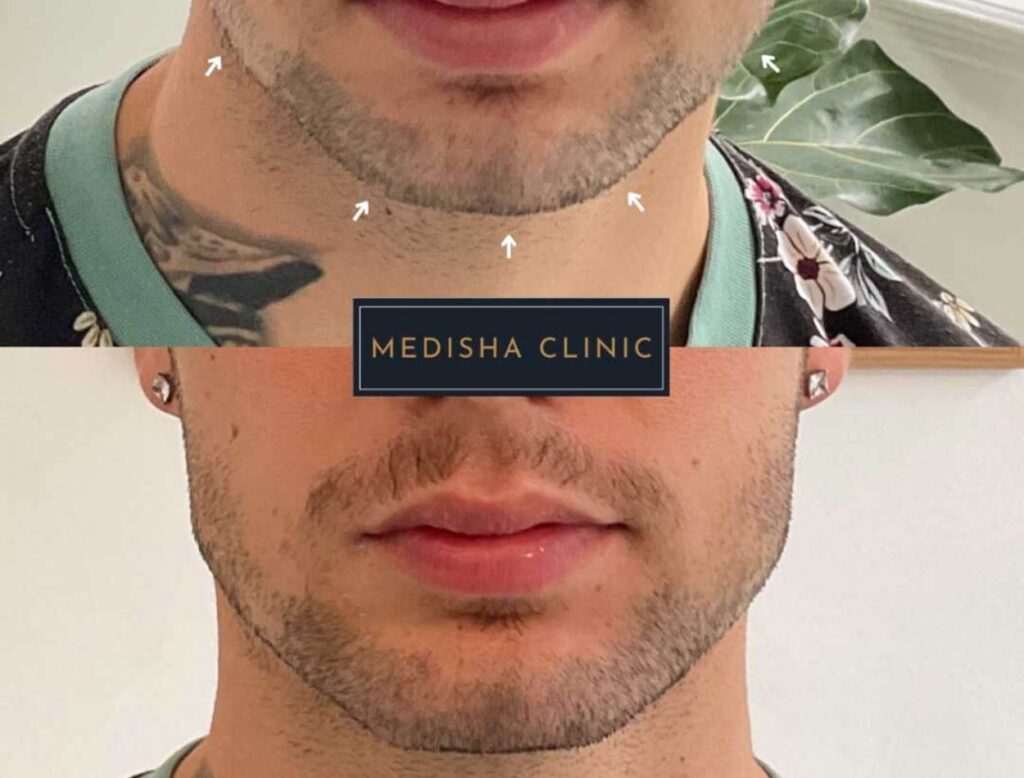
Close-up of a man’s before and after from jawline and chin post-treatment, illustrating the structured, angular result achievable with filler-based masculinisation.
Timeline, Results, and What Recovery Actually Looks Like
One of the most common questions men ask before treatment is: “How long before I look normal again?” The short answer is that for most people, looking “normal” is not far off at all. Here is a realistic timeline based on what the clinical evidence tells us.
- Immediately after treatment: Definition is visible straight away. The jaw will feel fuller and firmer. Mild swelling may make the treated area appear slightly over-corrected for the first one to three days, which is a normal response as the filler hydrates and settles.
- 24 to 48 hours: Minor swelling typically reaches its peak within 24 to 48 hours and then slowly resolves over several days. Most men return to work on the same day or the following morning. There is no clinical recovery time, but there might be some slight redness, swelling, or bruising at the injection sites, which should resolve within three to seven days.
- Days three to seven: Discolouration from any bruising typically fades within a week, though healing may vary. Any residual puffiness begins to settle visibly during this window. It is advisable to avoid hot environments until the swelling has fully resolved, including hot showers, saunas, and sitting out in the sun.
- Days seven to fourteen: The filler integrates properly with surrounding tissue and the final shape becomes clear. Swelling typically resolves within two to seven days, bruising within five to ten days, and final results are visible at around two to four weeks.
- Longevity: Results for male dermal fillers last on average between 12 and 18 months. Longevity depends on the area and product: cheeks tend to last 12 to 18 months, while jawline filler can last up to 24 months. Most men return for a top-up or maintenance session once results begin to soften naturally.
- What to avoid after treatment: Refrain from heavy exercise for a minimum of 24 to 48 hours, as excessive sweating and increased blood circulation can lead to swelling or bruising. Avoid alcoholic beverages, hot tubs, saunas, and steam rooms for 24 to 48 hours since they can potentially stimulate inflammation. Avoid pressing or massaging the treated areas unless your practitioner specifically asks you to.
How Much Does Masculinisation Treatment Cost in London?
Pricing is not one-size-fits-all. It depends on the number of areas treated, the volume of product needed, the practitioner’s qualifications, and the clinic’s location. Cost varies from client to client, depending on the amount of filler to be placed, and this will be discussed during a personal consultation and agreed as part of an individualised treatment plan.
To give you a realistic sense of what to expect in London:
- Single area (e.g., chin only): Typically around £400 to £700, depending on the volume of filler required. Structural zones such as the jawline and chin can require three to four millilitres before the change is noticeable, so a chiselled jawline treatment at a London clinic may reach £1,000 or above when priced per millilitre.
- Jawline treatment: Jawline filler in the UK typically costs between £400 and £1,200, depending on the amount of filler used, the clinic location, and the practitioner’s expertise.
- Full masculinisation package (jaw, chin, and cheeks combined): A masculinisation package including jawline augmentation, cheek, and chin fillers can set you back around £2,500 at some London clinics. This reflects the higher volume of product and clinical time involved.
- Why London pricing is higher: Prices in the UK reflect strict product import standards, 20% VAT on cosmetic work, high practitioner insurance, and mandatory emergency-drug stocking. Cutting those corners may reduce the fee but significantly increases the risk.
- Choosing a qualified practitioner: Aesthetic medicine is not a regulated title in the UK, but the initials after your injector’s name matter. Doctors, dentists, and nurse prescribers pay higher insurance premiums, invest in regular complication training, and hold prescription-only dissolving agents on site. That extra safety net is reflected in the fee.
All pricing figures above are indicative market ranges for London in 2025 to 2026 and may not reflect current pricing at any specific clinic. Always confirm costs in a consultation before proceeding.
Going Deeper: Myths, Misconceptions, and What Actually Determines a Natural Result
Most first-time visitors arrive with two concerns above all others: “Will it look fake?” and “Will people be able to tell?” These are completely fair questions. The answer to both depends largely on who does the treatment and how they approach it, not simply on whether fillers were used at all.
“Only surgery can give a man a stronger jawline”
This is one of the most persistent misconceptions, and the evidence does not support it. Masculinisation fillers offer a non-surgical alternative to achieving a more masculine facial appearance. Unlike invasive surgical procedures such as jaw augmentation or rhinoplasty, fillers can enhance facial contours without the need for incisions or lengthy recovery times. Surgical jaw implants are an option, but they carry general anaesthetic risks, extended downtime, and a fixed result that cannot be adjusted. Filler offers flexibility, as the effects are temporary and can be adjusted over time, unlike permanent surgical alterations. For most men who are not seeking a dramatic structural overhaul, well-placed filler is a clinically appropriate first step.
“Fillers will make my face look puffy or feminine”
This fear comes from seeing over-filled results, usually in women, and imagining the same happening to a male face. The reality is that masculinisation focuses on lateral support and structural enhancement over the cheekbone, specifically avoiding rounded or “apple” cheeks. The entire philosophy is different. The jawline and chin are used to give structure and a masculine look, with filler working by widening the corner of the jaw to create a more square front and side profile, and making the chin more angular for a more chiselled appearance. The cheeks are positioned lower to match the angles of the jaw, creating a more masculine appearance. Put simply, the goal is structure and angles, not inflation.
Natural-looking masculinisation depends far more on technique than on volume. A practitioner who understands male facial anatomy will use less product and place it with more precision than one who simply applies more filler in the same places used for women.
Will people notice I have had work done?
This is the big one. Research shows men worry disproportionately about potential negative consequences of facial aesthetic treatment, such as appearing more feminine or looking obviously altered. The clinical reality is that subtle, well-executed treatment does not announce itself. In masculinisation, subtlety is key. The best results do not shout “I had work done.” They convey a refreshed, balanced, and structured appearance, consistent with masculine facial proportions. Most men prefer subtle changes over dramatic transformations, and a well-designed treatment plan provides natural-looking results that colleagues and friends will notice as “looking refreshed” rather than obviously treated.
The honest answer is: if treatment is conservative, staged over time, and performed by an experienced medical professional, the people around you are more likely to think you have been sleeping well or going to the gym than to guess you have visited a clinic.
Younger men vs. older men: does the approach change?
Yes, meaningfully so. Younger men benefit primarily from targeted structural definition, while older men achieve better results when fillers are combined with treatments that improve skin quality. A man in his late twenties seeking greater definition has very different clinical needs from a man in his fifties who has lost facial fat over time and wants to restore structure. Fillers are also beneficial if you have experienced age-related volume loss, as they restore definition and create a sharper, youthful look. The consultation process at a quality clinic will account for this properly rather than applying the same template to everyone.
Who Is a Good Candidate for Non-Surgical Masculinisation?
The treatment is genuinely broad in its suitability, but it does work better for certain goals than others. Facial masculinisation with dermal fillers is a popular choice for both cisgender and transgender men, as well as non-binary individuals desiring a more masculine facial structure.
You are likely to benefit from masculinisation treatment if you have a weaker or recessed chin, a jawline that lacks definition or angles, or if you want to enhance your facial structure without undergoing surgery. These treatments are ideal if you have a weaker jawline, less-defined cheekbones, or a recessed chin and want a more sculpted, masculine appearance. If you want a balanced, symmetrical face or need to correct asymmetry from genetics or past injuries, fillers provide a precise, non-invasive solution. They are also a strong option for those who prefer gradual enhancements rather than permanent surgical changes, allowing for adjustments over time to achieve the desired aesthetic.
It is also worth understanding the cultural shift behind the rise in demand. According to Barclays data, male spending in the broader category of beauty, health, and pharmacy has increased by 58.1 percent since 2020, outpacing the 45.7 percent growth in women’s spending in the same area. BAAPS reported a rise in non-surgical procedures for men in 2024, and clinics are seeing men tend to start with small, practical steps like anti-wrinkle injections or skin boosters, and then move on to more structured treatment plans once they see results. Masculinisation treatment fits naturally into that journey for many men.
Why Medisha Clinic Is the Right Choice
Masculinisation treatments at Medisha Clinic are led by Dr Nish Shah, a medically qualified aesthetics doctor with extensive experience in advanced facial contouring and male-focused aesthetic enhancement. Dr Nish developed his art through masterclass training in advanced procedures including cheek augmentation, non-surgical rhinoplasty, and chin and jaw augmentation, and serves as a brand ambassador and Key Opinion Leader for Intraline, global leaders in the innovation of high-quality PDO threads, dermal fillers, and skincare. Clinics located in reputable areas such as Mayfair, including Medisha Clinic, have seen growing demand among male clients for masculinisation procedures , and the team’s approach, combining clinical precision with a genuinely conservative aesthetic, means results that enhance rather than overstate.
Frequently Asked Questions
What exactly is masculinisation treatment?
Facial masculinisation is a set of procedures designed to give the face characteristics that are socially associated with masculine traits. In a non-surgical context, this means using hyaluronic acid dermal fillers placed strategically at the jaw, chin, cheekbones, and sometimes the brow or nose to create sharper angles and stronger definition. Masculinisation treatments are not about altering someone’s identity. They are about refining and accentuating naturally masculine features: a stronger jawline, a more pronounced chin, a balanced profile, and overall facial harmony.
Will the results look obvious or unnatural?
When the treatment is planned correctly and delivered by an experienced medical professional, it should not look obvious. In masculinisation, subtlety is key. The best results convey a refreshed, balanced, and structured appearance consistent with masculine facial proportions. This demands a skilled, nuanced approach: the right filler amounts, careful placement, and an understanding of how male facial anatomy differs from female. Starting conservatively and building over time is the most reliable way to achieve a natural-looking outcome.
How long do results last?
Facial masculinisation with dermal fillers is not permanent. Results typically last between 12 to 18 months, depending on the areas treated and the type of filler used. Regular maintenance sessions help sustain the desired look, with the flexibility to make adjustments as needed. Some firmer fillers used in structural zones such as the jawline may last closer to 24 months. Your practitioner will advise on the specific products used and their expected longevity for your individual anatomy.
Does the treatment hurt?
Most men describe the sensation as mild pressure or a slight stinging rather than pain. While some patients may experience mild sensations such as pressure or stinging during the injections, it is generally well-tolerated, and any discomfort is typically temporary. At Medisha Clinic, topical anaesthetic is applied before treatment begins, and only the finest needles are used as standard. Individual pain thresholds vary, so if you are concerned, mention it at your consultation and the team can discuss options.
How long is the recovery time?
There is no surgical recovery period. Recovery is minimal, with most clients resuming their normal activities the same day. Mild swelling or bruising may occur but generally subsides within a few days. Strenuous exercise and heat exposure (saunas, steam rooms) should be avoided for 48 hours. Most men are comfortable returning to work or social activity the following day, though some minor puffiness may be visible for three to five days in some cases.
Can masculinisation treatment be reversed if I change my mind?
Yes. Hyaluronic acid fillers, which are the standard product used for non-surgical masculinisation, can be dissolved using an enzyme called hyaluronidase if you are unhappy with the result or develop an unexpected reaction. This is one of the significant advantages of the non-surgical approach compared to implants or surgical augmentation. Always confirm that your chosen practitioner holds hyaluronidase on site before proceeding, as this is a clinical safety requirement.
I am considering this for gender-affirming reasons. Is non-surgical masculinisation a realistic first step?
Aesthetic medicine offers non-surgical options for masculinising the face. They are less invasive, provide immediate or short-term results, and can be an alternative or complement to surgery. Treatments such as dermal fillers with hyaluronic acid, used to widen the jaw, project the chin, or enhance the cheekbones, are among the most requested. For many transgender and non-binary individuals, non-surgical treatment is a meaningful and accessible starting point, either alongside hormone therapy or independently. A thorough consultation with a practitioner experienced in working with transgender and non-binary patients is always the right first step.
What is the difference between masculinisation fillers and standard jawline or chin fillers?
The distinction lies in intent and technique rather than the product itself. Standard jawline or chin filler simply adds volume or projection to a single area. Masculinisation treatment takes a whole-face approach, considering how each feature relates to the others. Non-surgical facial masculinisation focuses on enhancing the underlying structure rather than simply adding volume. The practitioner considers the ratio of the jaw width to the chin projection, the position of the cheeks relative to the angles of the jaw, and the overall balance of the face. Treating areas in isolation without this context can produce results that look disconnected or, in some cases, feminising rather than masculinising.
How do I know whether to start with jaw filler, chin filler, or both?
This is precisely what a proper consultation is designed to determine. Every face is as unique as a fingerprint, which means there is no one universal approach to facial masculinisation. The goal of any treatment plan is to create a harmonious face that reflects the patient’s desired aesthetic. Some men have a strong chin but a soft jaw angle; others have the reverse. Treating one without the other can create imbalance. A good practitioner will photograph your face from multiple angles, map the structural relationships between features, and recommend a sequenced plan that builds towards the overall result rather than treating areas in isolation.
This article is intended as general educational information only and does not constitute professional medical or aesthetic advice. Results vary significantly between individuals depending on anatomy, lifestyle, and the products and techniques used. Any pricing mentioned is indicative of current London market ranges and is subject to change; always obtain a written quote from your practitioner before proceeding. Nothing in this article should be read as a diagnosis or a guarantee of any particular outcome. If you are considering masculinisation treatment or any aesthetic procedure, please consult a qualified, medically trained professional before making your decision. To discuss your individual goals with the team at Medisha Clinic, we would encourage you to book a consultation directly with the practice.