


How Long Does Chin Filler Last, And What Affects It?
Key Takeaways
- Typical longevity is 12 to 18 months. Most patients in the UK see their chin filler results last within this window, though individual variation is significant.
- Filler type is the single biggest variable. Hyaluronic acid (HA) products generally last 12 to 18 months, calcium hydroxylapatite (CaHA) fillers such as Radiesse can extend to 18 to 24 months, and collagen-stimulating injectables such as Sculptra may last two years or beyond.
- Lifestyle factors genuinely shorten results. Smoking, high-intensity exercise, UV exposure, dehydration, and poor sleep all accelerate the breakdown of filler in the tissue.
- The chin is one of the longer-lasting areas of the face. Because the chin sees far less dynamic movement than the lips or nasolabial folds, filler placed here degrades more slowly.
- Injector skill and product placement matter as much as the filler itself. Deep, supraperiosteal placement using a structurally appropriate, high-viscosity product gives more durable results than shallow injection with a soft-tissue filler.
Chin filler typically lasts between 12 and 18 months for most patients in the UK, though the range runs from as little as nine months to well over two years depending on the product used and how your body responds. Understanding what sits behind that variation is genuinely useful, because it affects not just when you might need a top-up but how much you will spend over time and which product is actually worth choosing for your goals.
How Chin Filler Works: The Basics Before the Timeline
It helps to understand what is actually happening under the skin before asking how long it will last. Chin filler is a non-surgical treatment that uses injectable dermal filler, most commonly a hyaluronic acid (HA) gel, to add projection, define the chin border, and improve the balance of the lower face. The practitioner places the product in precise locations, often directly onto or just above the periosteum (the bone surface), using either a fine needle or a blunt cannula depending on the goals and anatomy involved.
- Consultation and facial mapping. A thorough assessment of your profile, chin projection, and lower face proportions shapes the treatment plan. The amount of product, the injection depth, and the exact placement points are all decided here, not on the day of treatment.
- Topical anaesthesia. A numbing cream is applied to the treatment area to minimise discomfort. Most patients report feeling light pressure rather than pain during the injections themselves.
- Product placement. The depth and placement of the injection can significantly alter the final results. Supraperiosteal injections are used to create a structural chin framework, adding strength and projection. Subcutaneous injections offer smoother transitions and contours, providing a more natural look. A skilled practitioner will select the appropriate technique for the outcome you are seeking.

A practitioner marking the chin area before treatment to map injection points for projection and symmetry.
- Shaping and review. After the product is injected, gentle moulding may be used to distribute the filler evenly. The practitioner assesses symmetry and projection before the session ends. You will see an immediate difference after injection, but the final shape fully settles within 7 to 10 days as the filler integrates and swelling goes down.
- Aftercare and follow-up. Patients are advised to avoid touching or pressing the area for the first 24 to 48 hours, to stay out of saunas and intense heat, and to attend a review appointment at around two weeks once swelling has fully resolved. Swelling typically lasts 2 to 7 days and peaks at around 48 hours.
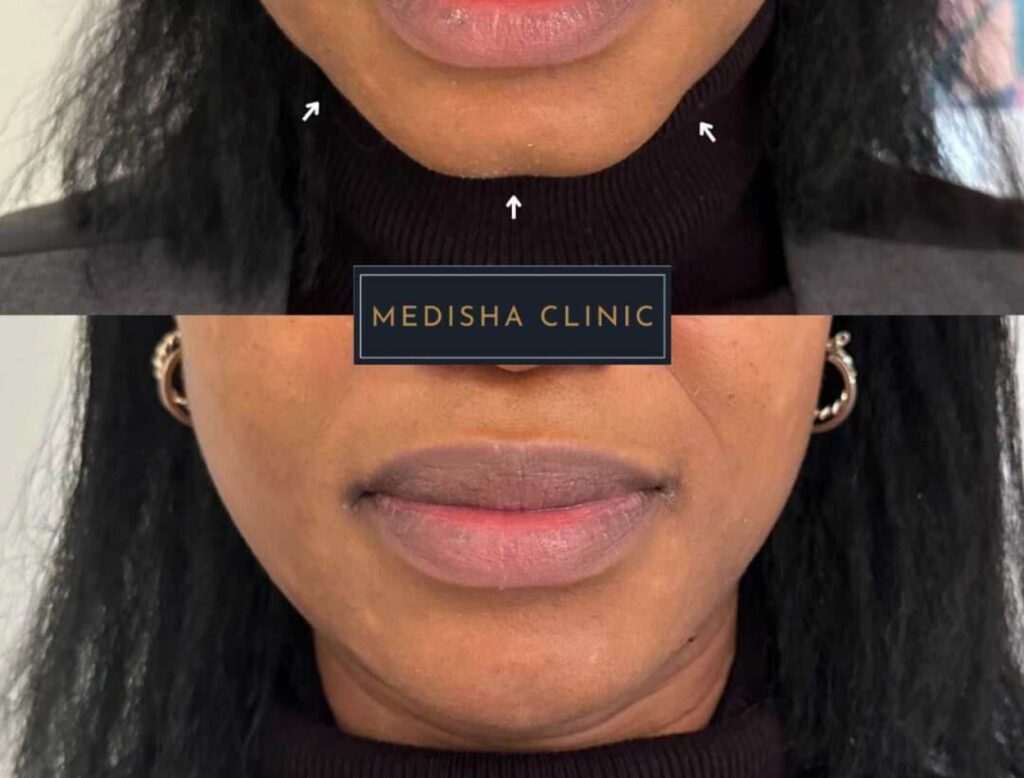
A before-and-after profile view showing improved chin projection and lower-face balance following dermal filler treatment
How Long Does Chin Filler Last in the UK: A Realistic Timeline
The honest answer is that it varies, and any practitioner telling you otherwise is oversimplifying. That said, the evidence from clinical practice in the UK clusters consistently around a central range.
- The typical window: 12 to 18 months. On average, chin filler lasts between 12 and 18 months, depending on the filler used, your metabolism, and lifestyle habits. This is the range most UK clinics quote, and it is broadly consistent with what practitioners see in real-world treatment schedules.
- Why the chin lasts longer than other areas. Typically, the effects of chin filler last between 12 to 18 months, depending on individual factors. Since the chin is a relatively static area compared to the lips or areas affected by dynamic expressions, it tends to retain filler longer. Lips, for comparison, often need attention every six to nine months because of constant movement during eating, speaking, and facial expression. The chin simply does not move that much.
- Some patients see results extend further. Some patients retain results for up to 24 months, especially with collagen-stimulating fillers like Radiesse. This is not the norm with standard HA products, but it is achievable with the right combination of product choice and favourable patient factors.
- Results fade gradually, not suddenly. One of the reassuring aspects of dermal fillers is that they break down slowly. This gradual process allows the skin to adjust without sudden changes. You will notice a steady decrease in plumpness and volume over time. Most patients find they become aware their filler is fading over several weeks, rather than waking up one morning to find it gone.
- Top-up timing. To maintain your desired look, schedule follow-up treatments every 12 to 18 months, or as advised by your practitioner. Many experienced practitioners recommend booking a top-up slightly before you feel the result has completely dissolved, as treating tissue that still has some existing filler often requires less product and produces a cleaner, more natural correction. Early intervention before complete filler breakdown often requires less product for touch-ups.
What Chin Filler Costs in the UK, and How to Budget Across Top-Up Cycles
Pricing for chin filler in the UK varies considerably by clinic, region, and product. Understanding the cost structure properly helps you avoid making a decision based on a headline figure that does not tell the full story.
- Per-syringe pricing. Dermal fillers in the UK cost between £150 and £1,500 depending on the treatment area, the brand of filler, how many ml you need, and the practitioner. A single 1ml syringe typically costs £200 to £600.
- How many syringes does chin filler need? A modest chin augmentation focusing on projection alone can often be achieved with 1ml to 1.5ml. Patients wanting more significant contouring or who are combining the chin with pre-jowl or jawline work may need 2ml or more. Jawline and chin contouring is one of the most requested treatments for both men and women. It creates sharper definition, improved symmetry, and a stronger profile, but it also requires more filler than most other areas, typically 2 to 4ml.
- HA versus alternative products. Standard HA fillers are typically at the lower end of the pricing range. Calcium hydroxylapatite fillers such as Radiesse expect to cost more, and these last longer and are thicker, so clinics typically charge £400 to £1,000 per session. Poly-L-lactic acid fillers like Sculptra, which stimulate collagen production over time, can range from £400 to £800 per session, often requiring multiple sessions for optimal results.
- Think in multi-year budgets. In the context of chin augmentation cost, remember filler is paid per ml/syringe and requires maintenance, so think in multi-year budgets rather than a one-off fee. A patient spending £350 to £450 on HA chin filler annually is spending a very different amount over five years compared to someone who invests in a collagen-stimulating product that holds for two years or more. Both can represent good value; the right choice depends on your goals.
- Cheaper is not always more cost-effective. A good filler result is never just a product purchase. It is an anatomical assessment, a treatment plan, careful placement, proper aftercare, and often a realistic conversation about whether one syringe will be enough at all. A very low quoted price can indicate a less experienced practitioner, a non-medical setting, or the use of unbranded product with no traceable supply chain. Dissolution and re-treatment if something goes wrong costs considerably more than getting it right the first time.
The Factors That Actually Determine How Long Your Chin Filler Lasts
This is where the post moves beyond a simple headline answer and into the detail that is actually useful. Longevity is not one thing; it is the combined result of several independent variables, some within your control and some not.
Filler Type and Formulation
Hyaluronic acid fillers typically last 12 to 18 months, and calcium hydroxylapatite fillers such as Radiesse can last 18 to 24 months and stimulate collagen. Thicker, firmer fillers designed for structural support generally last longer. This is not just a commercial claim; it reflects a real difference in how these materials behave in tissue. Sculptra creates volume by stimulating your biology, while dermal fillers create volume by adding a physical gel. This fundamental difference drives every other comparison: timeline, longevity, treatment areas, reversibility, and candidacy.
For the chin specifically, the product’s G-prime (its stiffness and resistance to deformation) matters a great deal. Chin and jawline work involves deep structural augmentation using high G-prime fillers. A high-G-prime product placed correctly on the periosteum holds its shape, provides projection, and degrades relatively slowly. A softer product designed for fine lines or lips would not give the same structural durability in this location.
Your Metabolism
Just as your metabolism plays a role in virtually every function of your body, so does your metabolism affect how long your chin filler lasts. A faster metabolism means you break down the filler quicker, shortening its lifespan. This is one of the factors that is largely outside your control. Younger individuals with higher metabolic rates may see their filler results diminish faster. It does not mean younger patients are poor candidates; it simply means they may need to top up on a slightly shorter schedule.
There is also an enzymatic component. Individual variations in hyaluronidase enzyme activity, the enzyme that breaks down hyaluronic acid, can significantly impact filler longevity. Some patients naturally have higher levels of this enzyme in their tissues, which means their HA filler dissolves more quickly regardless of other factors. This is difficult to predict in advance and can only really be established after your first treatment.
Lifestyle Factors
Several everyday habits have a measurable effect on how quickly filler degrades. Smoking and excessive sun exposure can degrade skin quality and accelerate the breakdown of dermal fillers, leading to shorter-lasting results. Nicotine constricts blood vessels and reduces blood flow, which can accelerate the breakdown of fillers. It also damages collagen and elastin in the surrounding tissue, which affects how well the skin holds the shape the filler creates.
Regular exercise can increase blood circulation, which may speed up the absorption of dermal fillers. That does not mean you should stop exercising. Doctors suggest that you do not give up exercise as your actual health should always be prioritised over your aesthetic needs. Regular exercise is still recommended, but it should be done in moderation. Avoiding intense high-impact training for the first 48 hours post-treatment is a sensible precaution; after that, normal activity is fine.
A diet rich in antioxidants and healthy fats can promote skin health, while dehydration can cause your skin to become more prone to filler breakdown. Hydration is particularly relevant for HA fillers, as hyaluronic acid works by attracting and binding water molecules in the tissue. Proper hydration helps maintain the integrity of hyaluronic acid fillers, as these products attract and retain moisture. Saunas, hot tubs, and intense UV exposure such as tanning beds can potentially shorten the lifespan of your filler.
Injector Skill and Placement Depth
This is probably the least-discussed factor in patient-facing content, but it matters considerably. Fillers placed at the correct depth for each specific area tend to last longer and provide better results. Using the right filler for each specific area and patient ensures optimal longevity.
The skill and technique of the professional administering the filler can impact how well it is placed and, consequently, how long it lasts. Precise placement can optimise the filler’s endurance. For the chin, the gold-standard approach for projection involves supraperiosteal placement, meaning the product is deposited directly on the bone surface. Filler placed at this depth is more stable, better supported, and less prone to movement than product placed more superficially. It also sits further from superficial vessels, which matters for safety.
The volume used also plays a role. The amount of filler injected can influence how long the results last. Smaller quantities may be metabolised more quickly, while larger volumes can provide a more sustained effect. A conservative first session may fade faster than a more complete treatment; this is one reason why some practitioners take a staged approach over two visits rather than placing the full desired volume in a single session.
Chin Filler vs. Alternatives: Honest Comparisons Patients Actually Want to See
Most people asking “how long does chin filler last” are not just wondering about a single treatment. They are thinking about whether this is the right route at all, and whether there are alternatives that would give them more durable results. Here is where those comparisons actually land.
HA Filler vs. Calcium Hydroxylapatite (Radiesse)
Hyaluronic acid is the most widely used option for chin filler in the UK, and for good reason. The most commonly used chin fillers in the UK are made from hyaluronic acid due to their high levels of safety and reliability, and the effects are immediate and last 12 to 18 months. A critical safety advantage: HA fillers can be reversed using hyaluronidase, a safety net many patients appreciate. If you dislike the result, or if a rare vascular complication occurs, the product can be dissolved.
Calcium hydroxylapatite (CaHA), sold as Radiesse, works differently. It provides immediate volume but also stimulates the body’s own collagen production over time. CaHA fillers can last 18 to 24 months and stimulate collagen. The trade-off is that Radiesse cannot be dissolved with hyaluronidase, so the reversibility safety net is removed. It tends to suit patients who have already been treated with HA, understand what they like about their result, and want a longer-lasting version of it.
HA Filler vs. Sculptra (Poly-L-Lactic Acid)
Longevity is where Sculptra holds a clear advantage. Sculptra results last an average of 25 months after the final treatment session, with some patients maintaining visible improvement for up to 3 years. Because the results are made of your own collagen, they fade very gradually, much like natural aging.
However, Sculptra is not a like-for-like swap for HA chin filler. Sculptra may require multiple treatment sessions over several months before noticeable results are seen, due to its collagen-stimulating properties which build up gradually and naturally. If you need an immediate, specific projection result, HA filler will deliver it in a single session. Sculptra is better suited to patients who want gradual, soft volume restoration in the lower face over a course of treatments, and who are not in a rush to see results.
Chin Filler vs. a Surgical Chin Implant
A question that comes up often, particularly among patients who have had chin filler two or three times and are starting to wonder if surgery would be simpler. The comparison is worth making directly. Because filler gradually breaks down in the body, the results are temporary, typically lasting 12 to 18 months. A chin implant is a surgical procedure designed to permanently enhance the size and shape of the chin. Implants do not dissolve. They are permanent unless surgically removed.
The financial comparison is not as simple as “filler is cheaper.” Chin implant surgery in the UK typically costs £2,500 to £5,000 or more, and while filler has a lower upfront cost, it is temporary and may require repeat treatments over the years, whereas implants provide a one-off permanent structural change. Over ten years, a patient having annual chin filler sessions may spend a similar total sum to someone who had a single implant procedure.
That said, filler holds a significant practical advantage. Your face changes with age. Volume shifts, skin laxity develops, and facial proportions evolve. One of the genuine advantages of chin filler is that it can be adjusted at each appointment to respond to those changes, keeping results looking natural and proportionate over time. A surgical implant, by contrast, remains static while the face around it continues to change. This can, in some cases, lead to results that look less natural over the years.
Many practitioners recommend chin filler as a trial run before implants, allowing patients to see how a more projected chin affects overall appearance and facial balance. That is a sensible approach. You cannot easily undo a permanent implant. You can dissolve HA filler.
The Migration Question: What Is True and What Is Myth
Concern about filler migration comes up regularly in patient consultations, and it deserves a clear answer rather than reassurance that glosses over the facts. One of the concerns patients raise is that chin filler will migrate to other areas of the face. While filler migration can occur, it is quite rare when performed by an experienced, licensed medical injector who uses proper technique, the appropriate dermal filler for the treatment area, and correct placement depth.
If migration does occur, it is most often downward, creating unwanted fullness or a look of heaviness under the chin. This usually relates to technique, such as placing filler too superficially, overfilling the area, or poor product control, rather than the filler itself. Chin filler does not migrate easily when placed correctly. The chin is composed of dense tissue and strong supporting structures that limit movement.
If migration does occur with an HA product, it is not permanent. Migrated filler will eventually dissolve on its own as the body breaks down hyaluronic acid. However, for quicker and more targeted correction, enzymatic dissolution with hyaluronidase is often recommended by practitioners. The key message is this: choosing a trained, medically qualified practitioner who uses appropriate technique and product selection is the most effective way to minimise the risk.
Why Medisha Is the Right Choice
At Medisha, our approach to chin filler is built on clinical accuracy, honest expectation-setting, and a treatment plan that evolves with your face over time rather than simply adding product at each visit. We take the time at consultation to understand your anatomy, discuss which product genuinely suits your goals and lifestyle, and explain exactly what you can realistically expect from your result. If you are ready to find out whether chin filler is right for you, book a consultation with our team today.
Frequently Asked Questions
How long does chin filler last in the UK on average?
Chin filler typically lasts 12 to 18 months, but duration varies between patients. Longevity depends on the filler type, amount used, injection depth, metabolism, facial movement, and lifestyle factors. Some patients with slower metabolisms and careful aftercare habits may find their result holds well beyond 18 months, particularly with denser structural products. Others with high metabolic rates or certain lifestyle factors may notice softening closer to the 12-month mark. Your practitioner can give you a more personalised estimate after a face-to-face assessment.
Does chin filler last longer than lip filler?
Yes, typically by quite a significant margin. Lip filler usually needs refreshing every six to nine months because the lips are in constant motion during eating, speaking, and facial expression. The chin is a relatively static area compared to the lips or areas affected by dynamic expressions, and it tends to retain filler longer. There is a common misconception that chin filler requires frequent maintenance appointments every few months. In reality, chin filler tends to last significantly longer than filler in more mobile areas of the face. Because the chin experiences less movement, the filler breaks down more slowly. Most patients find they need touch-ups only once every 12 to 18 or more months, so chin filler is a relatively low-maintenance treatment option.
Can I make my chin filler last longer?
You can certainly influence longevity through lifestyle choices, though some factors, like your natural metabolism, are not within your control. Practically speaking: protect your skin from excessive sun exposure and use SPF daily, as UV radiation degrades both skin quality and HA filler. Sun exposure damages skin and also breaks down hyaluronic acid. Stay well hydrated, as HA fillers depend on water-binding to maintain their volume. Avoid smoking, which damages collagen and accelerates filler breakdown. Avoid saunas, hot tubs, and intense UV exposure such as tanning beds, which can potentially shorten the lifespan of your filler. A good skincare routine and consistent SPF use are the two simplest and most effective steps any patient can take.
What happens when chin filler wears off?
One of the reassuring aspects of dermal fillers is that they break down slowly. This gradual process allows the skin to adjust without sudden changes. You will notice a steady decrease in plumpness and volume over time. Most patients describe it as simply returning to where they started, rather than a visible or sudden change. If you have been attending regular top-up appointments before complete dissolution, you are unlikely to notice a dramatic difference at any single point. The chin does not “sag” or appear worse than before treatment as a result of the filler wearing off; it simply gradually reverts to its pre-treatment appearance.
Is chin filler reversible if I change my mind?
Hyaluronic acid chin filler, which is the most widely used type in the UK, can be fully reversed using an injectable enzyme called hyaluronidase. Unlike chin implants, chin filler is reversible. If an individual is not satisfied with the results or wishes to explore alternative options in the future, the filler can be dissolved using an enzyme called hyaluronidase. Dissolution is a clinical procedure in its own right and should be performed by a trained practitioner, but it is straightforward when carried out correctly. Non-HA products such as Radiesse or Sculptra do not share this reversibility, which is an important consideration when choosing your product.
How much does chin filler cost as an ongoing treatment in the UK?
Dermal fillers in the UK usually cost £200 to £600 per syringe. For chin-specific treatment, a single syringe of 1ml is often sufficient for a focused projection result, though some patients and some treatment goals require more. Bear in mind that the per-syringe price is only part of the picture. The total cost over time depends on how often you need a top-up, which is determined by the product used and your individual response. A patient using a longer-lasting CaHA or Sculptra product may spend more upfront per session but less across a two-year period compared to annual HA treatments. Always ask your clinic for a clear breakdown of what is included in the quoted price, including consultation, product, follow-up, and aftercare support.
How does chin filler differ from jawline filler?
The chin and the jawline are adjacent structures but distinct treatment areas with different goals. Chin filler focuses on the anterior projection point of the lower face, improving profile balance and defining the chin tip or border. Jawline filler, by contrast, runs along the body and angle of the mandible to create definition from the side and front, creating that square or sculpted lower-face appearance. The two are often combined for a complete lower-face contouring result. For enhanced facial aesthetics, many patients combine chin filler with jawline filler to balance the lower face for a sharper, more structured look. Both treatments use similar HA products and have broadly similar longevity, but they require different injection techniques and anatomical knowledge, so they should be treated as separate procedures rather than variations of the same thing.
What should I avoid after getting chin filler?
In the first 24 to 48 hours, the priorities are to avoid touching or pressing the treated area, to stay out of hot environments such as saunas and steam rooms, and to skip strenuous exercise. After treatment it is recommended to avoid strenuous activity, pressure on the chin such as sleeping face-down, or heavy manipulation of the area for the first 24 to 48 hours. After that initial settling period, you can return to normal life without significant restrictions. You can begin exercising after 48 hours. Arnica gel or cream can be helpful for any bruising, and keeping well hydrated in the days following treatment supports HA filler integration. Your practitioner will give you personalised aftercare advice at your appointment, and you should follow their specific guidance above any generic advice.
Can chin filler help with a receding chin or profile imbalance?
Yes, this is one of the most common indications for the treatment. Ideal candidates often struggle with a “weak” or recessed chin that seems to disappear into the neck. Others seek to smooth a deep cleft or replace volume lost to the natural aging process. Chin filler works well for mild to moderate projection deficits, and the results can make a meaningful difference to facial balance and profile without surgery. For patients with significant skeletal retrusion or those seeking a dramatic structural change that soft tissue cannot replicate, a surgical option such as a chin implant or sliding genioplasty may be a more appropriate discussion to have. A thorough consultation with a medically qualified practitioner will clarify which route is genu